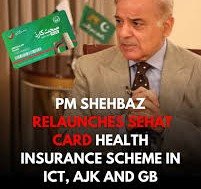
The Sehat Card Programme is one of Pakistan’s most impactful public healthcare initiatives, strengthened and expanded under Prime Minister Shehbaz Sharif to provide free and cashless medical treatment to deserving families. Designed to reduce the financial burden of healthcare, the Sehat Card works in close alignment with BISP Pakistan, the Benazir Income Support Program, and the 8171 SMS service, making it a core pillar of the country’s social safety net.
By integrating health coverage with welfare verification systems like BISP eligibility and 8171 NADRA verification, the Sehat Card ensures that low-income households receive timely, dignified, and transparent healthcare support.
Overview of the Sehat Card Program
The Sehat Card enables eligible families to access treatment at empaneled public and private hospitals without paying out-of-pocket. Under PM Shehbaz Sharif’s leadership, the program has been positioned as a complementary initiative to poverty alleviation schemes such as the BISP cash program and the Ehsaas program.
Families already registered under BISP registration or receiving BISP financial assistance often qualify automatically, as their data is verified through national systems. This integration minimizes duplication and improves service delivery across welfare programs Pakistan.
How Sehat Card Connects with BISP Pakistan
Healthcare and financial vulnerability are deeply linked. Many households benefiting from BISP cash grants or a BISP stipend struggle with medical expenses that can wipe out monthly support amounts. The Sehat Card directly addresses this gap.
Key linkages include:
- Use of BISP eligibility criteria and BISP means test data
- Verification through BISP NADRA verification
- Coverage prioritization for families meeting BISP family income thresholds
This approach ensures that healthcare benefits reach those who genuinely need them, reinforcing trust in the Benazir Income Support Program.
Eligibility Criteria for Sehat Card
Eligibility for the Sehat Card is closely aligned with BISP beneficiary requirements.
Generally eligible families include:
- Households registered in BISP Pakistan
- Families verified through BISP survey
- Beneficiaries who meet BISP eligibility criteria
- Individuals confirmed via 8171 NIC check
Citizens can confirm their eligibility using the 8171 SMS service, the same system used for BISP check status and welfare verification.
Registration and Verification Process
Most eligible families do not need a separate application if they are already enrolled in BISP registration. However, verification remains essential.
Ways to Verify Eligibility
- BISP online registration records
- Visits to BISP registration centers
- 8171 check via SMS by sending CNIC to the 8171 code
- Confirmation through BISP check status portals
This seamless integration ensures transparency similar to the BISP application process.
Benefits and Healthcare Coverage
The Sehat Card provides extensive healthcare coverage, offering relief beyond what BISP amount per cycle or BISP payment schedule can cover.
Key Benefits
- Free hospitalization and surgeries
- Emergency and specialized treatments
- Access to empaneled private hospitals
- Cashless treatment nationwide
For families relying on BISP financial assistance, this prevents healthcare costs from consuming their BISP cash program benefits.
Role of 8171 SMS Service in Sehat Card
The 8171 SMS service is a critical tool for beneficiaries to track welfare and health eligibility.
Through 8171 Pakistan, users can:
- Perform 8171 balance check
- Conduct 8171 status check
- Verify 8171 BISP status
- Confirm 8171 Ehsaas status
- Track 8171 payment status
Understanding how to use 8171 and the correct 8171 SMS format empowers beneficiaries to stay informed without visiting offices.
Tracking Status and Updates
Beneficiaries can stay updated through:
- Check 8171 status via SMS
- BISP 8171 check for welfare linkage
- BISP status 8171 verification
- BISP payment check 8171
Regular 8171 alerts and 8171 notifications ensure families are informed about eligibility changes, 8171 latest payments, and healthcare coverage updates.
Support, Helplines, and Complaints
To maintain accountability, multiple support channels are available:
- BISP helpline for eligibility and payment queries
- BISP contact number for registration support
- BISP SMS service for quick updates
- Formal BISP complaints mechanisms for grievance redressal
These systems mirror the transparency principles applied in the Sehat Card program.
Sehat Card and Pakistan’s Social Safety Net
Under PM Shehbaz Sharif, the Sehat Card has become a healthcare extension of Pakistan’s broader social safety net. When combined with:
- BISP cash grants
- 8171 financial assistance
- 8171 Benazir Income Support
- 8171 Ehsaas
it creates a multi-layered protection system that addresses both income insecurity and health emergencies.
Impact on Poverty Alleviation
Medical expenses are a major cause of poverty. By eliminating hospital bills, the Sehat Card strengthens:
- Long-term poverty alleviation schemes
- Household financial stability under BISP Pakistan
- Trust in welfare programs Pakistan
Families can now use their BISP stipend for education, nutrition, and livelihood instead of healthcare debt.
Conclusion
The Sehat Card program of PM Shehbaz Sharif represents a landmark shift toward inclusive healthcare in Pakistan. By integrating with BISP registration, BISP eligibility, and the 8171 SMS service, it ensures that healthcare reaches the same vulnerable families supported through cash assistance.
Together, the Sehat Card, Benazir Income Support Program, and 8171 Pakistan form a unified system that protects dignity, reduces poverty, and saves lives—making free healthcare not a privilege, but a right for every deserving citizen.
Readmore: Sehat Card